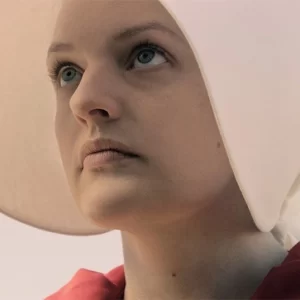
The Handmaid’s Tale showed the ease with which the unthinkable can become ordinary—a lesson crucial in the age of the Big Lie.
In June 2019, Kylie Jenner shared with the world some pictures of a birthday party she’d thrown for a friend. The event had a theme: The Handmaid’s Tale. It featured guests garbed in blood-red gowns; servers dressed as “Marthas,” or women enslaved for household labor; and drinks with such names as “Under His Eye tequila” and “Praise Be vodka.” The whole thing was cringey and absurd. It was also, as so often happens when the extended Kardashian family is involved, grimly eloquent. One of the lessons of The Handmaid’s Tale is the ease with which horror can become a habit. In a culture that is adept at turning tragedy into comedy, even the darkest of dystopias might be consumed, in the end, as a signature cocktail. Banality has its allure.
When the TV version of The Handmaid’s Tale premiered in 2017, the show was a textbook piece of Trump-era resistance art—a direct reply to the preening misogynies of the newly elected president. Both the book and the show were timely parables of gendered violence, reminders that history can also move backwards. And they retain that power today: The Trump administration may have concluded, but its encroaching cruelties have not. State leaders are currently attempting to legislate away the rights of, among many others, trans people, of other LGBTQ people, of women. But The Handmaid’s Tale is urgent again for another reason as well. Lawmakers in several states, empowered by the nearly friction-free spread of Trump’s Big Lie, are attempting to limit people’s ability to vote—and building the power to cast as “fraudulent” those electoral outcomes they find politically inconvenient. They are doing much of this in a way that might be familiar to Atwood’s readers: They are treating these elemental threats to democracy as if they were business as usual.
“This may not seem ordinary to you now, but after a time, it will,” Aunt Lydia, whose job is to indoctrinate young women into the ways of Gilead, assures her charges. “It will become ordinary.” She means this as a promise, but in truth, it is a threat. Gilead, like many of the real-world regimes that inspired it, uses ordinariness as a tactic of oppression. Much of its propaganda is aimed not at angering people, but at soothing them. Its invented language is strategically casual. In this world, ritualized rapes are known as “ceremonies”; murders of dissidents are dismissed as “salvagings”; violence is made so routine that it becomes unremarkable. In a story full of villains, ordinariness is its own kind of enemy.
The book’s narrator, Offred, understands that. She expends much of her energy simply resisting the urge to see what is happening to her and around her as anything but horrific—anything but shocking. This is one form of resistance: Nolite te bastardes carborundorum. Don’t let the bastards grind you down. The regime that has conquered much of America in The Handmaid’s Tale takes advantage of the fact that, in times of crisis, people’s desire for normalcy can be so deep that it can easily edge over into complacency. “The new normal,” in this universe, is not a cliché. It is a concession. ……..