You don’t have time to read it all. Make sure you read Stable Genus.


Keeping Homo Sapiens sane and informed in uncertain times. Nurturing the goodness that brings us together.
Shining a light on the dark forces that threaten our democratic society.

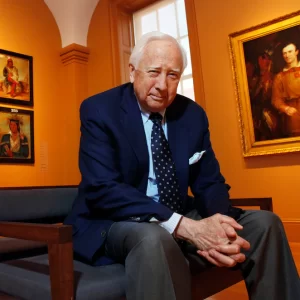
David McCullough, master chronicler of American history, dies at 89

Washington Post
By Glenn Rifkin

The two-time winner of the Pulitzer Prize was a best-selling author who brought to life the grand sweep of time and place.

David McCullough was a young researcher at the U.S. Information Agency when he walked into the Library of Congress in 1961 and chanced upon a photography exhibit depicting the 1889 flood in Johnstown, Pa., the deadliest in American history.

“I was overwhelmed by the violence revealed in them, the destruction,” Mr. McCullough, who was from the same area of western Pennsylvania, later told the Johnstown Tribune-Democrat. More than 2,200 people died, and a thriving coal-and-steel town was submerged in muddy debris because wealthy industrialists had neglected a dam.
The passage of time had reduced the tragedy to a historical footnote, Mr. McCullough discovered, with little if any serious scholarly study devoted to it. Undaunted by his own inexperience — “I imagined myself being a writer, but never a writer of history,” he said — he set out to write a book about the Johnstown flood.

“The Johnstown Flood,” published in 1968, became a bestseller, rekindled national interest in the disaster and instantly established its author as a historian with an exceptional gift for animating history.

Mr. McCullough, long regarded as a master storyteller of American daring, endeavor and perseverance, died Aug. 7 at his home in Hingham, Mass. He was 89.

His daughter Dorie Lawson confirmed the death but did not cite a specific cause.

In a career spanning more than five decades, Mr. McCullough turned out hugely popular tomes about such subjects as the building of the Panama Canal and the Brooklyn Bridge. He put a spotlight on the largely unknown but extraordinary people who battled disease, bureaucracy and graft to see such awe-inspiring visions accomplished.

When he turned his attention to the great forces and figures in American history, such as the American Revolution (“1776”) or President Theodore Roosevelt (“Mornings on Horseback”), he brought to life the grand sweep of time and place, as well as the colorful, minute historical details that characterized his widely lauded storytelling skills.

With his sonorous and somber voice, commanding presence and shock of white hair, Mr. McCullough appeared frequently on television series such as PBS’s “American Experience.” He often collaborated with filmmaker Ken Burns and narrated Burns’s Emmy Award-winning documentary series “The Civil War.”

“He’s had a profound influence on all I’ve done because he taught me how to tell a story,” Burns told an audience in 2015.

Mr. McCullough’s honors included two National Book Awards and the Presidential Medal of Freedom, presented in 2006 by George W. Bush.

“History matters. That’s what I’ve tried to convey,” Mr. McCullough told the Patriot Ledger of Quincy, Mass., in 2017. “It’s essential to understand our nation’s story, the good and the bad, the high accomplishments and the skulduggery. And so much of our story has yet to be told.”