American couples didn’t let pandemic isolation go to waste.
When the pandemic began, I didn’t place any bets on what the future would hold. But if I had, I would certainly be out a lot of money. One of my expectations was that pandemic-induced economic uncertainty would result in a baby bust. I had research on my side indicating that unemployment leads to reduced conceptions. Others made similar predictions—Brookings Institution researchers forecast in June 2020 that the pandemic would result in up to half a million fewer births in 2021. “Recessions mean fewer children,” they wrote.
But they, and I, were wrong. Couples didn’t let pandemic isolation go to waste. A new paper published by the National Bureau of Economic Research (NBER) actually detected an American baby bump in 2021, the first major reversal in declining domestic fertility rates since 2007. In total, about 46,000 more kids are running around out there than anticipated. Or perhaps crawling around.
So what happened?
For years, america’s fertility rates have been declining, captivating the attention of academics and journalists. As the demographic researcher Lyman Stone wrote in 2018, “Around the country, maternity wards are seeing less demand for their services, churches are seeing fewer babies brought in for baptism, and toy stores are struggling to stay in business. Fewer babies are being born in absolute terms and especially in terms of the national birth rates. Depending on how it is measured, birth rates are either at their lowest point in history or approaching it quickly.” If fertility rates had held steady at 2008 levels from 2009 to 2019, Stone estimates that America would have almost 6 million more kids today than it does. That’s a massive shift.
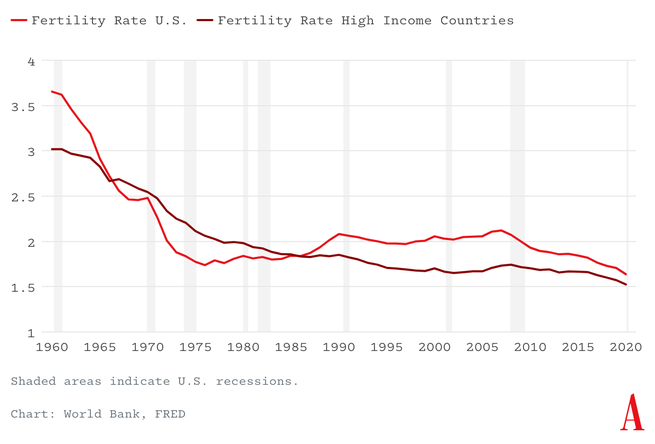
Domestic fertility rates matter in part because many American women report having fewer kids than they want. If they can get closer to their ideal family size, that’s a good thing. Fertility rates also matter because America is getting old. People are living longer (that’s a good thing too), but a population needs balance. If you don’t have enough young people, you also don’t have enough people working, coming up with new ideas and technologies to make the world a better place. The tax base for important social programs dwindles, and—less tangibly—society becomes more biased against change. Older people tend to prefer stability, and if they dominate society and politics, they can prevent nations from taking appropriate risks.
At first, pandemic fertility trends seemed to validate the direction of the pessimistic predictions, if not the magnitude: The NBER researchers, the economists Martha Bailey, Janet Currie, and Hannes Schwandt, found that births fell by 76,000 (2 percent) in 2020 relative to pre-pandemic trends. But because the pandemic didn’t begin in earnest in the U.S. until March of that year, the researchers don’t attribute this decline to COVID-related woes. Most of the declines were driven by reductions in births to foreign-born mothers. U.S.-born women saw just a tiny decline, one the researchers called “too small to be statistically meaningful.”
Then rates turned sharply upward, if unevenly: The baby bump was not uniformly distributed across age groups, races, or educational attainment. The researchers found that women under 25 saw the greatest increase, indicating that the pandemic led some women to start families sooner than they otherwise might have. This line of reasoning is buttressed by the fact that first births boomed the most across 2020 and 2021, with almost 70,000 more first births than expected, versus not quite 12,000 second births, and about 45,000 fewer third and higher-order births. To me, the data tell a story of people with young kids experiencing the difficulties of remote schooling, losing access to routine child care (either from their parents or paid help), and putting off having more children in the face of these challenges. People without any kids, meanwhile, were actually gaining time, given the elimination of other potential activities by the pandemic shutdowns—and they used that time to become parents……