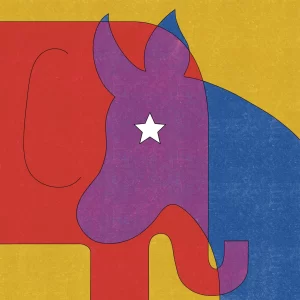
On June 7, I won the Democratic Party primary in New Jersey’s Seventh Congressional District, on my way to what I hope will be my third term in the House. The same day, I also accepted the nomination of the new Moderate Party, formed substantially by state Republicans fed up with the extremism of a party led by Donald Trump.
The Moderate Party is an experiment: an alliance between Democrats of all stripes, independents and moderate Republicans hoping to win an election while pursuing a reform to the election laws that could empower swing voters to save our democracy from toxic polarization.
Third-party candidates have long been viewed as spoilers in American politics, for good reason. Ralph Nader and Jill Stein had no chance of winning the presidency yet drew enough votes from Al Gore in 2000 and Hillary Clinton in 2016 to help tip those elections to Republicans. On the right, libertarian candidates tend to draw votes away from Republicans.
Fusion parties were common in 19th-century America. During the 1890s in North Carolina, for example, Republicans and Populists ran a unified slate that temporarily ousted the white supremacist Democratic majority.
In New York, the main parties operating under this system, the Working Families and Conservative Parties, occupy the left and right wings of the political spectrum. But if fusion parties were permitted nationwide, the political force most likely to form one would be the center. Such a party might be especially attractive to Republicans disgusted with their national party’s embrace of election lies, vaccine denial and QAnon conspiracy theories but who are turned off by the left wing of the Democratic Party and remain reluctant to pull its lever………