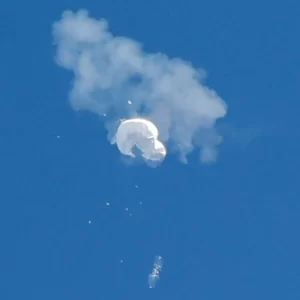
There is nothing new about superpowers spying on one another, even from balloons. But for pure gall, there was something different this time.
It may be months before American intelligence agencies can compare the audacious flight of a Chinese surveillance balloon across the country to other intrusions on America’s national security systems, to determine how it ranks.
After all, there is plenty of competition.
There was the theft of the designs of the F-35 about 15 years ago, enabling the Chinese air force to develop its own look-alike stealth fighter, with Chinese characteristics. There was the case of China’s premier hacking team lifting the security clearance files for 22 million Americans from the barely secured computers of the Office of Personnel Management in 2015. That, combined with stolen medical files from Anthem and travel records from Marriott hotels, has presumably helped the Chinese create a detailed blueprint of America’s national security infrastructure.
But for pure gall, there was something different about the balloon. It became the subject of public fascination as it floated over nuclear silos of Montana, then was spotted near Kansas City and met its cinematic end when a Sidewinder missile took it down over shallow waters off the coast of South Carolina. Not surprisingly, now it is coveted by military and intelligence officials who desperately want to reverse-engineer whatever remains the Coast Guard and the Navy can recover.
Yet beyond the made-for-cable-news spectacle, the entire incident also speaks volumes about how little Washington and Beijing communicate, almost 22 years after the collision of an American spy plane and a Chinese fighter about 70 miles off the coast of Hainan Island led both sides to vow that they would improve their crisis management.
“We don’t know what the intelligence yield was for the Chinese,” said Evan Medeiros, a Georgetown professor who advised President Barack Obama on China and Asia with the National Security Council. “But there is no doubt it was a gross violation of sovereignty,” something the Chinese object to vociferously when the United States flies over and sails through the islands China has built from sandbars in the South China Sea.
“And this made visceral the China challenge,” Mr. Medeiros said, “to look up when you are out walking your dog, and you see a Chinese spy balloon in the sky.”
As it turns out, it was hardly the first time. Hours before the giant balloon met its deflated end, the Pentagon said there was another one in flight, over South America. And it noted a long history of Chinese balloons flying over the United States (which the Pentagon, somehow, never wanted to talk about before, until this incident forced it to).
“Instances of this kind of balloon activity have been observed previously over the past several years,” the Pentagon spokesman, Brig. Gen. Patrick S. Ryder, said in a statement published on Thursday. One senior official said many of those were in the Pacific, some near Hawaii, where the Indo-Pacific Command is based, along with much of the naval capability and surveillance gear of the Pacific Fleet.
General Ryder’s admission raises the question of whether the United States failed to set a red line years ago about the balloon surveillance, essentially encouraging China to grow bolder and bolder. “The fact that they have come into airspace before is not comforting,” said Amy B. Zegart, a senior fellow at the Hoover Institution and the author of “Spies, Lies and Algorithms,” a study of new technologies in ubiquitous surveillance. “We should have had a strategy earlier,” she said, and “we should have signaled our limits much earlier.”