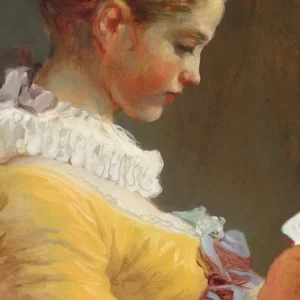
Romance novels celebrate female pleasure and aspiration.
One of my most enduring school memories is of an austere English teacher urging us—a class of two dozen 13-year-old girls with all the raging hormones of a Harry Styles arena tour—not to succumb to the books of Jackie Collins. “If you read trash, girls,” she articulated, with icy precision, “you will write trash.” Thinking back on this, all I can summon is: I wish. Collins sold half a billion novels during her life, made more than $100 million, and had a Beverly Hills mansion and a gold Jaguar XKR with the license plate lucky77. We should all be so blessed as to write like she did.
Still, for me, the message stuck—not a moralistic warning about the dangers of sexually explicit popular fiction, but an aesthetic one. The idea that “bad” novels could poison someone’s thinking, could plant roots in the recesses of her brain only to send out shoots of florid prose years later, was an alarming one. I read all of Jackie Collins anyway, while feeling slightly embarrassed about it, my initiation into a world where virtually everything that’s pleasurable for women is shaded with guilt. Her characters—bold, beautiful women striding through Hollywood in leopard-print jodhpurs and suede Alaïa boots—embodied a combination of desirability and ambition that was totally intoxicating to a British teenager with a school uniform and a clarinet. And her writing did settle into my subconscious, I can see now, but not at all in the ways my teacher feared it would.
Dip even a toe into the pool of popular fiction by women writers, and you’ll discover that this word, trash, has a long lineage. George Eliot, in her 1856 essay “Silly Novels by Lady Novelists,” excoriated what she interpreted as “the most trashy and rotten kind of feminine literature,” a genre of contemporary fiction that concerned itself merely with “the ideal woman in feelings, faculties, and flounces,” written by ladies in “elegant boudoirs, with violet-colored ink and a ruby pen.” One year earlier, Nathaniel Hawthorne, in a fit of pique, had vented to his publisher about the “damned mob of scribbling women” dominating the American literary market. “I should have no chance of success,” he pouted, “while the public is occupied with their trash.”
The intellectual disdain for novels enjoyed by women often went hand in hand with a paternalistic sense of unease about how these kinds of stories might influence the innocent, unsuspecting reader. “Let us go into the houses of the poor, and try to discover what is the effect on the maiden mind of the trash which maidens buy,” Edward G. Salmon suggested in his 1886 essay “What Girls Read.” “We should probably find that the high-flown conceits and pretensions of the poorer girls of the period, their dislike of manual work and love of freedom, spring largely from notions imbibed in the course of a perusal of their penny fictions.”