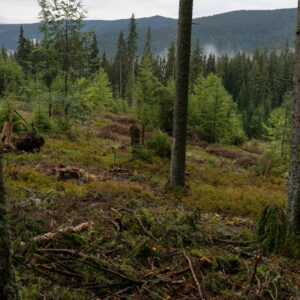
Governments bet billions on burning timber for green power. The Times went deep into one of the continent’s oldest woodlands to track the hidden cost.
Burning wood was never supposed to be the cornerstone of the European Union’s green energy strategy.
When the bloc began subsidizing wood burning over a decade ago, it was seen as a quick boost for renewable fuel and an incentive to move homes and power plants away from coal and gas. Chips and pellets were marketed as a way to turn sawdust waste into green power.
Those subsidies gave rise to a booming market, to the point that wood is now Europe’s largest renewable energy source, far ahead of wind and solar.
But today, as demand surges amid a Russian energy crunch, whole trees are being harvested for power. And evidence is mounting that Europe’s bet on wood to address climate change has not paid off.
Forests in Finland and Estonia, for example, once seen as key assets for reducing carbon from the air, are now the source of so much logging that government scientists consider them carbon emitters. In Hungary, the government waived conservation rules last month to allow increased logging in old-growth forests.
And while European nations can count wood power toward their clean-energy targets, the E.U. scientific research agency said last year that burning wood released more carbon dioxide than would have been emitted had that energy come from fossil fuels.
“People buy wood pellets thinking they’re the sustainable choice, but in reality, they’re driving the destruction of Europe’s last wild forests,” said David Gehl of the Environmental Investigation Agency, a Washington-based advocacy group that has studied wood use in Central Europe.
The industry has become so big that researchers cannot keep track of it. E.U. official research could not identify the source of 120 million metric tons of wood used across the continent last year — a gap bigger than the size of Finland’s entire timber industry. Researchers say most of that probably was burned for heating and electricity.
Next week, the European Parliament is scheduled to vote on a bill that would eliminate most industry subsidies and prohibit countries from burning whole trees to meet their clean energy targets. Only energy from wood waste like sawdust would qualify as renewable, and thus be eligible for subsidies.
But several European governments say that now is no time to meddle with an important energy industry, with supplies of Russian gas and oil in jeopardy. In the Czech Republic, protesters have mobbed the streets, furious with rising energy costs, and the French authorities have warned of rolling blackouts this winter.
Internal documents show that Central European and Nordic countries, in particular, are pushing hard to keep the wood subsidies alive.
The debate is an acute example of one of the key challenges that governments face in fighting climate change: how to balance the urgency of a warming planet against the immediate need for jobs, energy and economic stability. The European Union has been a leader in setting green policies, but it is also racing to find energy sources as Russia throttles back its supply of natural gas.
In documents circulated among lawmakers about the proposed rule change, Latvia warned of a “possible negative impact on investment and businesses.” Denmark argued that these decisions should be left to national governments. A winter without reliable Russian gas looms over the debate.
Scientists have warned of this moment for years……….