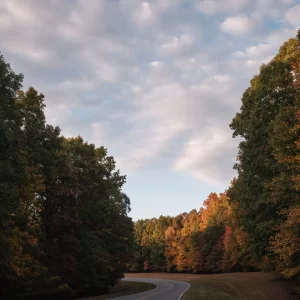
With no billboards or gas stations, a fall drive along this winding, verdant All-American Road, is a head-clearing journey, offering encounters with history, nature, music and more.
As I pulled away from the Loveless Cafe, near the northern end of the Natchez Trace Parkway, the rain clouds that had been brewing southwest of Nashville unleashed a shower over what, in the distance, looked to be tiny Bon Aqua, Tenn., where I once lived. There was a welcome touch of fall in the air, so I was willing to gamble on a little rain.
Nashville to Tupelo, Miss., 222 miles, is one half of the winding, verdant, 444-mile-long All-American Road known as the Natchez Trace Parkway. Overseen by the National Park Service, the route is free of billboards, traffic lights, stores, gas stations and commercial vehicles. It flows from Music City, where I now live, to the southern Mississippi town of Natchez, and memorializes the Natchez Trace, a frontier route used over the centuries by Native Americans, hunters, soldiers, early postal carriers, itinerant preachers and Kaintucks, traders who floated goods down the Ohio and Mississippi rivers from roughly the mid-1700s to the mid-1800s, then traveled north to their homes on foot. Thousands of years before its use by bipeds, the path was tamped down by what historians believe to be bison headed to the salt licks around Nashville.
I’d lived in Tennessee for years before I understood the significance of the parkway. A family emergency had upended my weeklong date with a Florida beach and I figured that a long drive unencumbered by traffic and signs would help me unwind while offering a close-up look at a travel route I’d heard about for decades. I had a mere two days to clear my head, and this road was built for head-clearing.
My original plan had been to attempt a carbon-reduced drive in an electric convertible, but as it turns out, there are currently no convertibles on the market. So I settled on a 2022 Hyundai Tucson Hybrid with a sunroof for $100 a day from Turo. I figured I would get a little of the quiet and fuel efficiency provided by an E.V., without needing to stop along the way for a recharge. Given my tight schedule, I was looking to save some time. (For those who are ready to hit the road in an all-electric car, the Natchez Trace Compact, a group of communities along the parkway that promotes travel, has compiled a list of battery-charging stations in nearby towns.)
Herds and horsemen
About half an hour after leaving the Loveless Cafe, the rain was behind me. I rolled down the windows and slowed to electric mode — roughly the speed limit of a school zone — to listen to the surrounding woods. A commotion of birds and insects descended on the car that was so loud I felt like I was driving through a rainforest. During the warm months, the simple two-lane road is so laden with greenery that the narrower sections are under a canopy of maple, hickory, oak and other hardwoods. In the fall, their leaves turn varying hues of copper, crimson and gold, a spectacular drive. Spring on the parkway brings the pink flowers of redbud trees and the paper-white flowers of dogwoods.
The National Park Service manages the Trace like a 444-mile-long greenway/civics lesson. Information kiosks and free-standing podiums tell the stories of those who used the Natchez Trace, of the inns and river ferries significant to its function, and of dramatic events such as the death of Meriwether Lewis that happened along the way. To keep track, I used the NPS trip planner, which offers a complex history of the Natchez Trace.
At about mile marker 428, I motored past the entrance to the town of Leiper’s Fork, the only historic district on the parkway, settled in the 18th century by Revolutionary War veterans. Leiper’s Fork would become a trade center for those traveling the Old Trace. Today, a suite of art galleries showcasing local artists, shops and a few Southern restaurants make up much of the business community, but it’s the town’s village feel that is a magnet for country music stars who make Leiper’s Fork their home. It’s the barbecue and original live music at the former Puckett’s Grocery & Restaurant (now called Fox & Locke, its original name) that’s been a magnet for those stars and pretty much everyone else over the years. Open mic night on Thursdays has always been worth the drive; you never know who will show up……….