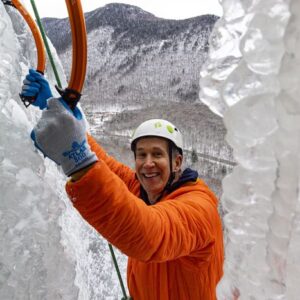
Physician Jim Baker lost his son in 2016. He says the intense workout that ice climbing demands is therapeutic.
Hospice physician Jim Baker deals with loss on a daily basis. But nothing prepared him for the pain of losing his youngest son in 2016.
In time, Dr. Baker found some solace in ice climbing. When he hangs onto the face of a 100-foot frozen waterfall with nothing but razor-sharp crampons and an eighth-of-an-inch-wide steel blade anchoring him to the ice, he is able to briefly forget. He says the world condenses down to the current moment as he focuses simply on a single point in the ice.
“The grief won’t ever go away, but for that time, it disappears,” he says. “I feel exhilarated and alive.”

Jim Baker says ice climbing forces him to forget his worries and be in the moment.
Dr. Baker, 69, also rock climbs, but he says ice climbing requires an intense focus that is therapeutic. The sport is similar to rock climbing, he says, in that your body must be balanced in a tripod stance and you must constantly be thinking about your next move. But ice is more unforgiving, he says.
“If you slip climbing rock, you can catch yourself. But with ice you have tools in your hands,” he says. “Ice is harder to read—it melts and breaks. I’ve seen huge ice daggers release off the wall.”
As you ascend, you kick your crampons up and into the ice, not straight at it, he says. Once your feet are secure, you anchor ice axes overhead to climb.
Dr. Baker says his love of the sport motivates him to keep up his fitness levels year round and gives him a reason to look forward to frigid New England winters.
When patients at the end of their lives tell him how they wish they could get out and do something like ice climbing, it reminds him to appreciate every adventure, even when temperatures dip into single digits.
The Workout
Dr. Baker ice climbs at least once a week in the winter, with a typical season starting in December and ending in April. His go-to climbing area is Frankenstein Cliff in New Hampshire’s Crawford Notch State Park, which is about a three-hour drive from the inpatient hospice facility where he works in Haverhill, Mass. He leaves after work for overnight trips. “My wife always gets a call at day’s end so she knows I’m OK,” he says.
A climbing session spans between eight and 10 hours. His workout starts even before he begins climbing.
“Sometimes it takes 90 minutes to two hours to reach good ice,” he says. “You have to walk in heavy boots with a 40-pound pack, and the snow can be deep.”
Dr. Baker works out with a personal trainer for over an hour, twice a week. He met her after suffering a back injury more than a decade ago. Workouts involve intense strength training using free weights, as well as exercises to improve balance and flexibility.Lat pull-downs, pull-ups, kettlebell swings and renegade rows, where he grips a 60- to 65-pound dumbbell in each hand while holding a plank pose, and alternates rowing each up to his side, are routine upper-body exercises. He does walking lunges, squat variations and leg presses for his lower body.
He does yoga-inspired exercises and stretches before he heads to the mountains to climb, and supplements ice climbing with indoor climbing. In the summer, he plays golf. “The first time I sunk an ax into ice I thought, this is so similar to swinging a golf club,” he says. “The two motions are very similar, with the acceleration coming from the release of your wrist.”
He incorporates as much movement into his days as possible, taking stairs instead of the elevator and parking in spots that require him to walk more.
The Diet
Breakfast: Plain Greek yogurt topped with berries and V8 juice.
Ice climbing fuel: He carb-loads with calorie-dense foods the morning of a climb and loads his pockets with things he can eat with his gloves on, like Clif Bars and gels. “I always have a big thermos of hot chocolate,” he says.
Lunch: BLT with avocado and an apple.
Dinner: Different types of beans mixed with chopped tomato, onion, cilantro, and lime. After a day climbing, he feasts on lobsters or Mexican-spiced beef. “I’ve earned it,” he says.
Sweet tooth: “I lived on candy when I worked in the ER,” he says. Now, he rarely touches sugary treats, except for the occasional bowl of Ben & Jerry’s Cherry Garcia.
Essential Gear
Ice climbing requires a significant investment in safety equipment, including ropes and carabiners, as well as warm clothing, Dr. Baker says. He tries to support local businesses where he climbs, such as International Mountain Equipment in North Conway, N.H. Here are some of the basics.
Safety: Black Diamond Technician harness ($90) and Black Diamond Half Dome helmet ($60).
Technical Gear: Grivel G14 crampons ($260). He has more than a dozen ice axes. His favorite is his Cassin X-All Mountain hammer ($240).

Good gear is worth the investment to stay warm on single-digit days, he says.
Playlist
At the gym, he puts on classic rock, including the Doors and Led Zeppelin.
SHARE YOUR THOUGHTS
What has helped you to cope with grief at times of loss? Join the conversation below.
Write to Jen Murphy at workout@wsj.com
Copyright ©2022 Dow Jones & Company, Inc. All Rights Reserved. 87990cbe856818d5eddac44c7b1cdeb8