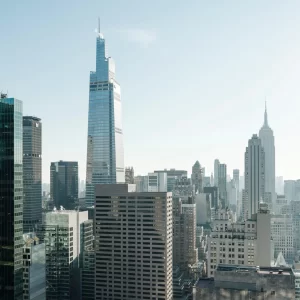
One Vanderbilt, in the heart of New York City, is built to be especially climate friendly. But the design landscape and city rules have changed quickly.
One Vanderbilt, a commanding new skyscraper in the heart of Manhattan, seems to be reaching for the future. One of the world’s tallest buildings, it pierces the sky like an inverted icicle and fuses seamlessly with an expanding network of trains and other transport at its foundations.
It is also the rare skyscraper designed with climate change in mind. It holds a self-contained, catastrophe-resilient power plant capable of generating as much energy as six football fields of solar panels. The building captures every drop of rain that falls on it, and reuses that runoff to heat or cool its 9,000 daily visitors.
“It’s a commercial-grade science project,” said Jonathan Wilcox, a director of engineering at SL Green Realty Corp., the company that owns it.
But One Vanderbilt is also something else. It is already out of date.
Some of the building’s most important green features were the right answer to the climate problem in 2016, when design work was completed. “And then the answer changed,” Mr. Wilcox said.
Unlike many skyscrapers, One Vanderbilt generates much of its own electricity. This was a leap forward a decade or so ago — a way of producing power that saved money for landlords and was cleaner than the local grid.
However, One Vanderbilt’s turbines burn natural gas. And while natural gas is cleaner than oil or coal, it is falling from favor, particularly in New York City, which in recent years has adopted some of the most ambitious climate laws in the world, including a ban on fossil fuels in new buildings.
As that transition happened, SL Green was caught in the middle. Although One Vanderbilt went up relatively quickly, topping out after three years, its owner had to watch as the city’s environmental strategy raced forward.
“Design horizons are longer than people think,” said John Mandyck, chief executive of the Urban Green Council, a nonprofit advocacy group. Still, Mr. Mandyck had praise for One Vanderbilt’s climate goals. “We have to celebrate the march of progress,” he said.
The building, which has 73 floors, plus an area on top with bars and observation decks, was 20 years in the making and sits just west of Grand Central Terminal. Given its marquee location and remarkable ambitions, it opened in late 2020 to less fanfare than one would imagine. At the time, the pandemic was raging and few were in the mood to celebrate a new office tower.
Since then, One Vanderbilt has garnered its share of acclaim, thanks to a popular viewing platform and the transformation of a congested block of Vanderbilt Avenue at the foot of the building into a car-free pedestrian plaza. The skyscraper’s underground plaza is an integral part of East Side Access, merging with the decades-in-the-making nexus of connections between Long Island Rail Road and Grand Central Terminal, which finally opened last month.
But the building’s flashiest components lie hidden from public view.
On the roof, 1,300 feet above midtown, cooling towers the size of a Brooklyn brownstone evaporate warm water pumped a quarter-mile skyward, discharging a haze similar to that of a football player removing his helmet in February. Like almost everything in One Vanderbilt, the process isn’t wasted. After losing its heat, the water is sent back downward to cool off machinery dozens of floors below.
On a recent morning, Mr. Wilcox and a trio of engineers huddled on the roof, their backs to the sort of knee-buckling view that tourists pay hundreds of dollars to experience from a helicopter. Nearby, five giant fans inside the cooling tower, each the size of a small windmill, quietly spun, recycling energy through the building….