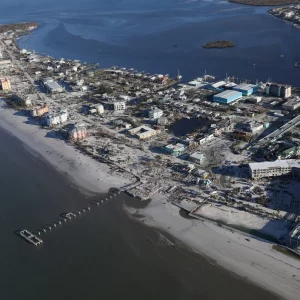
Hurricane Ian is the latest devastating hurricane to confirm that coastal areas are failing to keep rebuilt or new development out of highly vulnerable areas.
Local emergency managers know all too well which places in their communities should not be built back after a storm. But they are rebuilt, because the federal government and states provide multiple incentives to rebuild rather than to relocate. The assumption is that taxpayers will always be there to back up private investment after even predictable natural hazards.
Mantoloking, N.J., was a poster child in 2012 for Superstorm Sandy’s destructiveness. The barrier island that the borough sits on was ripped in half. Homes were destroyed. Even the areas of greatest destruction were rebuilt. We know it will happen again.
The money for such rebuilding comes largely through the public assistance sections of the 1988 Stafford Act. This legislation created the federal system of emergency response. When the president makes a federal disaster declaration for a county, aid dollars flow in with few strings attached.
Outside of disaster aid, billions of dollars a year are spent by the federal government on resilience projects. The bipartisan infrastructure act of 2021 allocated some $47 billion over several years for resiliency. Most of the funded projects are designed to protect existing infrastructure, in most cases with no demands for the recipients to improve long-term planning for disasters or to change patterns of future flood plain development.
Federal and state taxpayers have spent billions of dollars over the past four decades pumping up beaches in front of coastal properties in what are known as beach nourishment projects. In Florida alone, almost $3 billion in public funds has been spent just to keep beaches in front of investment homes and oceanfront infrastructure. Studies in Florida have shown that these beach projects increase oceanfront development. Government spending is incentivizing this expansion into danger zones — a classic example of moral hazard, in which there is no reason to protect against risk when the government or federally subsidized flood insurance is there to pick up the tab.
I am not callous about storm relief. There are many people who need help in Ian’s aftermath, and the first order of business must be ensuring they get that assistance. But a national conversation is long overdue about the dollars we invest in rebuilding coastal resort communities and what we should expect in return. At the moment, taxpayers are getting little back from these investments. The federal funds come with few restrictions at the local level to provide meaningful adaptation to future sea level rise and intensifying storms.
I frequently speak to community groups that ask me what the first step should be for adapting to sea level rise and storm impacts. My answer is simple. The easiest way to limit damage and loss of life is not to create vulnerabilities.
In Charleston, S.C., the city is considering moving forward with a $1.1 billion project, largely funded with federal money, to build an eight-mile-long sea wall to protect infrastructure at the same time it has approved a development on what is largely Guggenheim family land to place thousands of new structures in the flood plain. To me, that’s a problem.