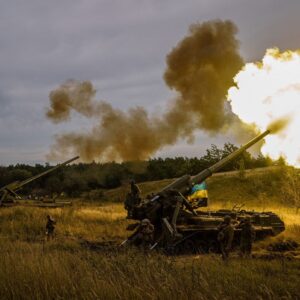
Ukraine’s friends should reinforce its success by sending more and better weapons.
One of the many excuses Vladimir Putin has given for invading the country next door is that Ukraine and Russia are “one nation”, which should be united under his benign rule. “Do you still think that?” asked Ukraine’s president, as his troops swept thousands of Russian invaders from Kharkiv province this week. Volodymyr Zelensky’s triumphant sarcasm was justified. The Kharkiv counter-offensive, which began on September 5th, marks the most dramatic Russian reversal since Mr Putin abandoned his effort to seize Kyiv, the Ukrainian capital, at the end of March.
Its significance is not just the liberation of 6,000 square kilometres of territory in a few days—more than Russia had gained in the previous five months. Nor is it Ukraine’s seizure of the tanks, guns and boxes of ammunition that the Russian soldiers left behind as they fled in disorder. Ukraine has also recaptured two transport hubs, Izyum and Kupyansk, which Russia needs if it is to complete its conquest of the Donbas region and integrate it into Russia. Mr Putin’s plans to stage phoney “referendums” on annexing occupied parts of southern and eastern Ukraine are now on hold, as Ukraine counter-attacks in both areas. Predictions in war are always risky, but the tide seems to have turned. Russia’s occupation is everywhere held in check, and Ukraine is gradually—and sometimes suddenly—rolling it back.
Ukraine’s battlefield advances rest on two pillars; materiel and men. In hardware it has an ever-increasing edge. America and other friendly states have sent it rockets with enough range and accuracy to shift the terms of engagement. Ukraine can see and reliably hit enemy ammunition dumps, command centres and logistics nodes far behind the front lines; Russia cannot. Russia’s supposed air superiority has been suppressed by mobile air defences. And whereas Russia is running down its stocks of weapons, Ukraine’s are growing both more plentiful and more powerful, as superior nato equipment replaces its old Warsaw Pact kit.
Ukraine’s manpower advantage is growing, too. Mr Putin’s original invasion force of 200,000 was never big enough to occupy Ukraine. (He imagined, apparently, that the Ukrainian opposition would obligingly collapse.) Russia’s losses have been terrible; by one estimate 70,000-80,000 of its soldiers have been killed or wounded. Despite raiding jails and offering huge bonuses, Mr Putin is struggling to replace them.
Ukraine, by contrast, has its entire adult male population to call on. Their morale is sky-high and, thanks partly to nato, they are well-equipped and increasingly well-trained. They will only gain in confidence as Russia falters. They are fighting for their homes and fellow citizens. Russia’s troops are fighting for a basket of lies: that Ukraine is run by “Nazis”, that it poses a threat to Russia, that its people want to be “liberated” by Russia. Mr Putin could in theory order a general mobilisation and force many more young Russians into battle; but he knows this would be wildly unpopular, which is why he has not yet done it. Even if he did, it would take many months to recruit, train, equip and deploy the reluctant and terrified reinforcements.
The West should, therefore, reinforce success. Ukraine has shown that it can use Western weapons to regain territory; the West should send better ones, such as longer-range atacms munitions for the himars launchers that have proved so effective, which it previously hesitated to supply. To avoid escalation, advanced nato weapons should not be fired into Russia; Ukraine will surely comply rather than alienate its arms supplier. It will also need a reliable flow of ammunition for future offensives and armoured vehicles to move forces fast. The West should also consider what Ukraine might need next year—and vastly expand the scale of training for Ukrainian troops abroad.